
AgentaOS
He could not take card payments from the Balkans. So he became the seller for everyone else.
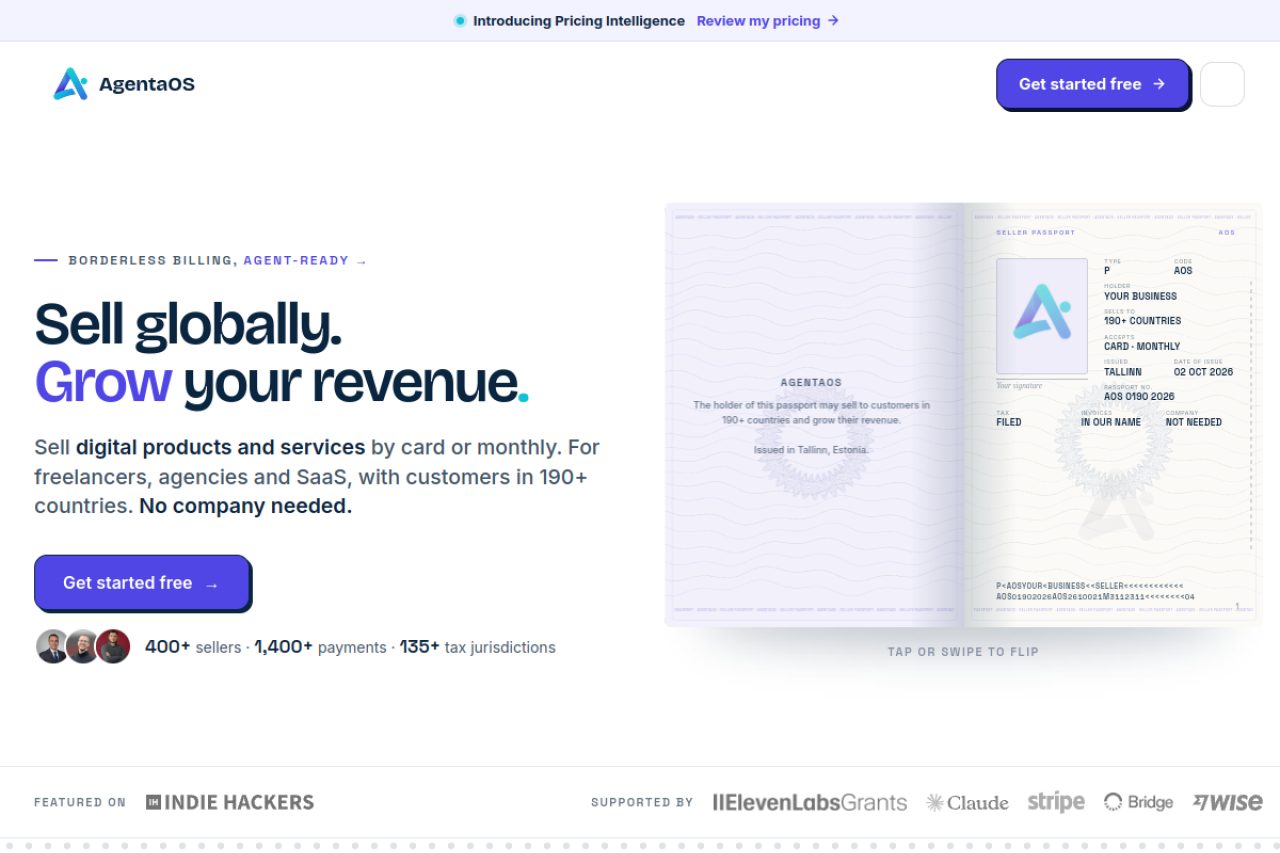
AgentaOS acts as merchant of record for freelancers, agencies and SaaS founders, handling cards, subscriptions, VAT and sales tax in more than 190 countries. Panche Isajeski launched it in August 2026 from Tallinn with no employees and reached $9,500 in monthly recurring revenue within two months.
What it is
If you sell software from a country that payment processors treat as a rounding error, you hit a wall fast. AgentaOS removes it by becoming the official seller of your product: it is the merchant on the record, it handles cards and recurring billing, and it deals with tax across nearly two hundred jurisdictions. You receive payouts to your own bank.
The founder has lived the problem. He tried to launch a product from the Balkans in 2021, could not integrate a subscription payment provider, and ended up incorporating in Delaware — which fixed payments and created a worse tax-reporting headache in its place.
How it makes money
A hybrid model: a percentage of every sale plus a monthly subscription, with the founder noting that it earned from day one. Payment partners take a cut of every transaction, so the margin per sale is thin — but with zero employees, almost all of the remainder stays in the business.
A later feature leans on the same alignment. The team realised the real obstacle for most customers was not taking payments but choosing a price, so they added AI pricing review. Because the company earns a share of each sale, helping a founder price correctly increases its own revenue.
Why it worked
The product was funded by a fintech consultancy the founder already ran, which removed the pressure to raise or to rush. The first attempt in this space, an experiment with stablecoins and agentic commerce, failed outright — the technology was ahead of the demand and cost about ten thousand dollars to learn from.
Go-to-market was entirely content and conversations: no ad spend, no SEO programme, just writing about the problem before the product, then onboarding every founder personally by call and in person. Three weeks after launch there were fifty verified founders and fifty thousand dollars processed. The founder's advice is blunt: charge from day one, and tie your revenue to your customers' success so the incentives point the same direction.
A caution
Note what is not being claimed here. This is a two-month-old business in a regulated industry with a thin margin per transaction, and the founder himself describes the earlier version as a costly lesson in building something nobody needed. The transferable part is the sequence — twenty years of domain expertise, a problem lived personally, a bootstrapped funding source, and manual onboarding of the first hundred customers — not the headline number.
Estimates, not audited figures · Last updated: 2026-10-15
Related profiles
NinjaPear
He lost the data source. So he rebuilt the product around not needing it.
ThreadRecap
Not a big business. A very efficient one.

Sleek
Three weeks of building, aimed at the least glamorous part of app design.
Keep exploring
110 profiles and counting — let fate pick the next one.
Frequently asked questions
What is AgentaOS?
A merchant of record service that lets freelancers, agencies and software founders outside the US and Europe accept card payments, subscriptions and handle tax worldwide.
How big is the team?
One person. The founder runs it alone, using AI agents for onboarding, support and much of the code.
What are the numbers?
More than 400 founders signed up and $9,500 in monthly recurring revenue two months after launch.